May 01, 2019
0

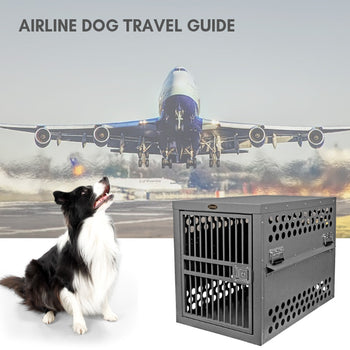
A road trip with a large dog is a different project from a road trip with a small one. A Labrador, a German Shepherd, or a Great Dane takes up real space in the vehicle, carries real force in a sudden stop, overheats faster than most owners expect, and can be turned away at a hotel desk for weighing too much. None of that is a reason to leave your dog at home. It is a reason to plan.
This guide walks through the whole trip in the order you will face it. You will get your dog and your vehicle ready, decide how a big dog should ride, plan stops and meals, manage heat, find lodging that actually accepts large dogs, and pack what you need. We have spent seven years helping dog owners build safer travel setups, and the trips that go smoothly almost always share one trait. The owner decided how the dog would be secured before deciding anything else.

Large dogs change the math on almost every part of travel. They need more cargo space, they are harder to lift if they get hurt, and they generally cannot ride in an airline cabin, which is one reason so many owners of big dogs choose to drive. Their size also means more momentum in a collision, more heat to shed on a warm day, and a narrower field of hotels that will take them. Planning for those four things, space, force, heat, and lodging, covers most of what can go wrong.
Book a visit a few weeks before you leave. Ask your veterinarian whether your dog's joints, weight, and heart are up to a long day of riding, whether vaccinations and parasite prevention are current, and whether medication for motion sickness makes sense. Ask which states on your route or at your destination require a health certificate, and carry your dog's rabies vaccination record either way.
Joint health deserves particular attention in large breeds, because repeated jumping in and out of a cargo area is hard on hips and elbows. A ramp is a small purchase that protects a big dog's joints, and it saves your back too.
A dog who handles a twenty-minute errand may struggle in hour three. Build up gradually with longer drives in the exact setup you plan to use, whether that is a crate, a barrier, or a harness, and finish at a place your dog loves so the car predicts good things.
If your dog drools, trembles, or gets sick on rides, solve that first. Our guide on how to keep your dog calm during car rides explains how to tell fear, excitement, and nausea apart and what helps each one.
A dog who slips loose at a rest stop or after an accident is in unfamiliar territory, which makes identification more important than it is at home. Confirm that your dog's microchip is registered with your current mobile number, put a tag with that number on the collar, and keep a clear, recent photo of your dog on your phone. If your dog ever gets loose two states from home, those three things are what bring the dog back.
The safest answer is secured, in the back of the vehicle, and never loose. Cars are built for people who are buckled in, and a dog who is not restrained becomes a projectile in a crash. The American Animal Hospital Association, citing Edmunds, has noted that a 60-pound dog thrown from a seat in a 35 mph crash can hit an object with about 2,700 pounds of force, and a larger dog carries more. The AVMA also warns that unrestrained pets can be thrown out of a vehicle or through a window or windshield.
Three common habits make things worse. Do not let your dog ride on a lap or in the front seat, since AAA warns that a front airbag can be deadly to a pet even when the pet is restrained. Do not let your dog hang its head out the window, where road debris can injure eyes and ears. And do not let a dog ride loose in an open truck bed or tether one there, because AAA notes that a dog can jump or be thrown out, and a tether can drag the dog along the road.
The law is also catching up. A few states, including Hawaii, New Jersey, and Rhode Island, have rules aimed at pets in moving vehicles, and drivers in many other states can be cited under distracted-driving laws when a loose dog interferes with driving. Rules change, so check every state on your route before you leave.

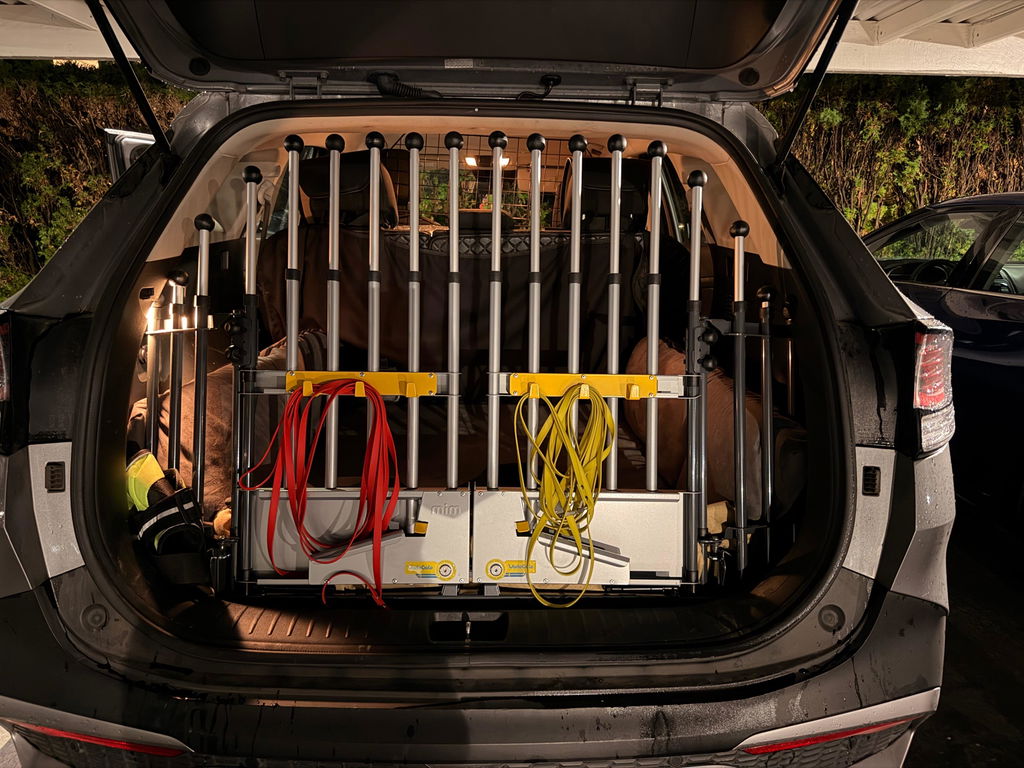
A crash-tested dog crate is the most protective option for most large dogs because it contains the dog and keeps the dog out of the passenger space. The MIM Safe Variocage Double suits large-dog households well. It is built for two dogs, but the center divider can be removed to give one big dog the entire space, and it comes in sizes up to XXL+ for large and giant breeds. MIM Safe states that the Variocage is certified to ISO 27955 and ECE R-17 and was tested by the SP Technical Research Institute of Sweden. Its steel, telescopic design is meant to work with your vehicle's crumple zone, and an emergency escape hatch lets you reach your dog through the folded-down rear seats if the tailgate will not open after a rear collision.
Fit matters as much as strength, and with a large dog it is easy to get wrong. Measure your dog from the tip of the nose to the base of the tail and add three inches. Then measure from the floor to the top of the shoulders and add three inches, so your dog can stand, sit, turn around, and lie down. Next, measure your vehicle's cargo area: the narrowest width across the floor, the usable length from the back seat to the door sill, and the lowest height at the hatch opening.
Our guide on what size dog crate you need for your car walks through the process. Our team also checks your numbers before an order ships and backs the fit with our Fit Guarantee. At each stop, a spill-proof water bowl designed for the Variocage lets your dog drink without a loose dish sliding around the crate between stops.

Some large dogs ride better with more room and a view, and some households carry two dogs plus gear. A crash-tested barrier or gate creates a secured zone in the cargo area of an SUV or wagon without fully enclosing the dog. The MIM Safe Variogate and the VarioBarrier Universal work together to build that zone.
Barriers suit calm dogs who settle on their own, because a dog who paces or climbs has more space to do it. Our comparison of a dog car barrier versus a crate explains how to decide between the two approaches for your dog and your vehicle.
A harness fits dogs who ride calmly on the back seat. The AllSafe dog seat belt harness is intended for the rear seat only and comes in four sizes. According to its manufacturer, it was crash tested with dummies weighing 50 and 75 pounds at speeds up to 30 mph, and sizing tends to run large, so measure carefully.
Because that testing stopped at 75 pounds, owners of giant breeds should talk with our team before relying on a harness. For the largest dogs, a crate or barrier is often the better match.
The Center for Pet Safety, a nonprofit that tests pet travel products, has long pointed out that the United States has no government performance standard for pet restraints. That means a crash-tested label can mean very little on its own.
Before you buy any crate, barrier, or harness, ask which standard it was tested to, which laboratory ran the test, what size dummy was used, and how the product attaches to the vehicle. Then compare the answers with your dog's weight. Our best dog crate for car travel safety guide breaks down these questions in more detail.
Pickup owners have a separate option. A dog box built for a truck bed keeps your dog contained and out of the open bed, which is far safer than letting a dog ride loose or on a tether. Our guide on how to choose a dog box for your truck explains what to look for.
Start with space. A large dog in a crate or behind a barrier uses most of an SUV's cargo area, so load your luggage around the dog's space and not into it. Pack heavy items low and secure them, because loose luggage becomes a second projectile. Check whether your vehicle has a raised sill at the rear opening, since a crate door needs room to open properly. If you are shopping for a new vehicle with a big dog in mind, our roundup of the best SUVs for dog owners looks past cargo volume to what matters for dogs.
Think about airflow and temperature next. Rear cargo areas often get less airflow than the cabin, so use window shades and run the rear vents or rear climate control where your vehicle offers them. Watch for heavy panting and drooling at every stop, because a dog in a crate cannot tell you when it is too warm.
Finally, bring the ramp. Even a dog who jumps in and out easily at home faces a higher step into a cargo area after hours of sitting, and a ramp spares the joints on a trip with many stops.

Veterinary and travel guidance generally lands on a stop every two to three hours for water, a bathroom break, and a walk, and AAA recommends that drivers stop about every two hours to rest. A large dog needs at least ten minutes on a leash to stretch and use the bathroom, so build the stops into your schedule instead of tacking them onto the end of it.
Always clip the leash before the door opens. A large dog who bolts at a busy rest area is hard to catch and dangerous around traffic. Use the designated pet areas that many highway rest stops provide, and never pull onto the shoulder to walk a dog.
How far to drive in a day depends on the dog. Healthy adult dogs can handle a full driving day when stops are regular, but puppies, seniors, and dogs with joint problems need shorter days and more frequent breaks. Let your dog's behavior set the pace, and consider building one shorter driving day into a multi-day itinerary.
Give your dog 30 to 45 minutes of walking or play in the morning, then let the dog cool down and drink.
Feed a light meal at least three to four hours before you leave, instead of right before loading up.
Take a final bathroom walk just before you load the dog into the vehicle.
Drive for two to three hours, then stop for a leashed walk, water, and a check of your dog's body language.
Save the main meal for the end of the day, after your dog has rested.
Walk your dog again at your overnight stop before settling in.
Keep your dog's food routine as normal as possible. Pack your dog's regular food plus at least two extra days of meals in case of delays, and skip new treats and table scraps on the road. Offer small amounts of water at each stop instead of letting your dog gulp a full bowl, and keep a gallon of water in the vehicle.
Large dogs face one risk that small dogs rarely do. Gastric dilatation volvulus, commonly called bloat, happens when the stomach fills with gas and twists. Cornell University's Riney Canine Health Center describes it as a condition that requires immediate medical and surgical treatment and notes that large, deep-chested dogs are most at risk. Cornell lists eating too quickly and exercising soon after eating among the risk factors, and the UK charity PDSA adds that vigorous exercise or traveling in a car after a meal can raise the risk. For a road trip, that means smaller meals, a slower pace at the bowl, and keeping the main meal for the end of the day instead of right before or after a drive.
Know the warning signs before you leave. A swollen or tight belly, repeated retching with little or nothing coming up, restlessness or anxious behavior, and collapse can all point to bloat. If you see them, do not wait to see whether they pass. Go to the nearest emergency veterinary hospital. Look up an emergency clinic near each overnight stop and near your destination, and save the numbers in your phone before you leave.
The AVMA reports that the temperature inside a vehicle can rise almost 20 degrees in 10 minutes and almost 30 degrees in 20 minutes. After an hour, the inside can be more than 40 degrees hotter than the outside. On a 70-degree day, the AVMA's table puts the interior at 89 degrees after 10 minutes and 113 degrees after an hour, and cracking the windows made very little difference in the study the AVMA cites.
That means the answer to "it will only take a minute" is always no. Plan meals so your dog never waits in a parked vehicle. Use drive-throughs, picnic at a park, choose restaurants with dog-friendly patios, or take turns so one adult eats while the other walks the dog. In warm weather, travel in the early morning and evening, and test pavement with the back of your hand before your dog walks on it, since hot pavement can hurt paws.
Large and giant breeds and dogs with thick coats struggle most. Signs of overheating include heavy panting, drooling, weakness, and bright red gums. If you see them, move your dog into shade or air conditioning, offer cool water, and call a veterinarian right away.
Pet-friendly does not always mean large-dog-friendly, and traveling with a large dog narrows your options quickly. Many hotels cap dogs at around 50 pounds, some set a combined weight limit per room, and policies can differ between two locations of the same brand. Pet fees are common, and NerdWallet's review of major chains found fees often running $50 to $150 per stay.
Call the specific property and ask about weight and breed limits, fees, how many pet rooms are available, and whether dogs may be left alone in the room. Then get the answers in writing. Vacation rentals with fenced yards are often easier for big dogs than hotel rooms, and extended-stay properties with kitchens simplify feeding schedules. Whatever you choose, book early, since pet-friendly rooms are limited and sell out in peak season.
Camping with a large dog works well, but public lands have their own rules. In national park units, dogs must be on a leash no longer than six feet, many parks keep dogs off hiking trails and out of the backcountry, and some restrict pets to roads, campgrounds, and developed areas. National forests and state parks often offer more trail access, so check each unit's pet policy page before you build an itinerary around a hike.
Do not tie your dog and walk away from a campsite, and never leave your dog in a vehicle at a trailhead. Temperatures rise quickly, and the National Park Service warns against leaving pets unattended.

Keep a dedicated dog bag within reach of the front seat so you are not unpacking the cargo area at every stop. Here is what belongs in it, plus what to keep in the glovebox or on your phone.
Rabies certificate and vaccination records, plus your veterinarian's phone number
The name and number of an emergency veterinary hospital near each overnight stop
Any prescription medications, with a few extra days of doses
Your dog's regular food, with at least two extra days of meals
Collapsible or spill-proof bowls and a gallon of water
A six-foot leash and a long line for safe sniffing at rest stops
Waste bags, paper towels, and a pet-safe cleaner for accidents
A towel and a blanket or bed that smells like home
A basic canine first-aid kit
A ramp or steps if your dog has trouble jumping
Window shades for the cargo area
A clear recent photo of your dog on your phone
Keep the paperwork in one folder and photograph each page as a backup. If something goes wrong, you will be glad you can find your dog's vaccination history in seconds.
After a collision, a frightened or injured dog may panic, run, or bite while rescuers try to help. A dog who gets out of the vehicle can be hit by traffic or lost. This is one more reason a secured dog is safer for everyone, and it is why an escape hatch on a crate matters if the tailgate will not open.
If your dog gets loose, contact the microchip registry, local animal control, and nearby shelters right away, and share your dog's photo with them. Ask nearby businesses to watch for your dog, and post the photo in local lost-pet groups.
If your vehicle breaks down in warm weather, get your dog into shade immediately and keep water within reach. Interior temperatures climb quickly, so a dog should not wait in a stalled car while you sort out the problem.
Plan a stop every two to three hours for water, a bathroom break, and a leashed walk of at least ten minutes. Puppies, seniors, and dogs prone to nausea may need more frequent stops. Never leave your dog in a parked vehicle during any stop.
The safest place is the cargo area of an SUV or wagon, secured in a crash-tested crate or behind a crash-tested barrier. A calm dog can also ride on the back seat in a properly fitted crash-tested harness. Keep dogs off laps and out of the front seat.
It is not recommended. AAA warns that a front airbag can seriously injure or kill a pet even when the pet is restrained, so the back seat or cargo area is the safer choice.
Measure your dog and your cargo area, then choose a crash-tested crate or barrier that fits both. Load luggage around the dog's space, add window shades for airflow and temperature control, and bring a ramp. Call us with your measurements and our team will help you confirm the fit.
Some do, but many cap pets near 50 pounds and charge fees. Policies vary by location, so call the property, ask about weight limits, and get the answer in writing. Vacation rentals with fenced yards are often easier for big dogs.
There is no fixed limit. Healthy adult dogs can handle a full driving day with regular stops, while puppies, seniors, and dogs with joint problems need shorter days. Let your dog's behavior set the pace.
Feed a light meal a few hours before the drive, keep the vehicle cool and ventilated, and build up trip length gradually. If drooling or vomiting continues, talk with your veterinarian about medication. Our guide on how to keep your dog calm during car rides explains the difference between fear, excitement, and nausea.
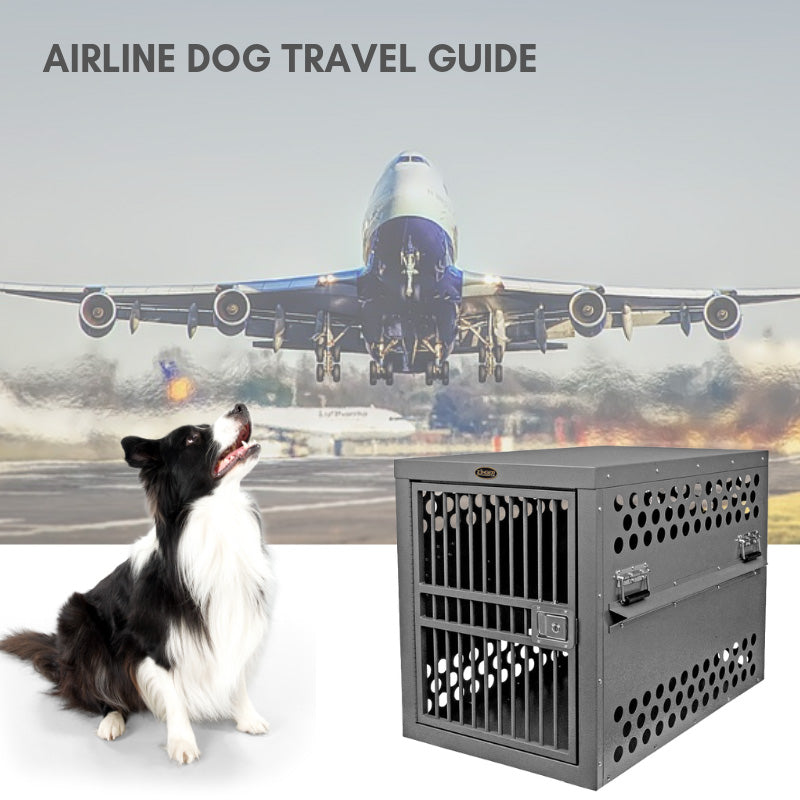
Large dogs generally cannot ride in the cabin, so they travel as checked pets or cargo in an airline-compliant crate, and airline rules vary. If flying is your only option, our complete guide to airline compliant dog travel explains the IATA crate requirements.
A road trip with a large dog rewards owners who handle the unglamorous details first. Decide how your dog will be secured, measure carefully, schedule stops and meals around your dog's needs, and never leave your dog in a parked vehicle. The scenery takes care of itself once those pieces are in place.
If you are building your travel setup, start with our crash tested dog crates for cars and our cargo gates and barriers. Fit depends on your dog and your vehicle, so when you send us your vehicle measurements, our US-based team will help you choose the right size and back it with our Fit Guarantee. Call 888-979-5566, start a live chat, or send a message through our contact page.
AdeoPets has served dog owners for seven years and holds a 4.9-star rating across more than 600 customer reviews. If you find a lower price online, our Price Match Guarantee has you covered.