May 01, 2019
0


At some point, almost every dog owner faces a version of the same decision: wire crate or aluminum crate? For some, it is an easy call. For others, it is the question they are still asking after replacing their second or third bent wire cage. The answer is not one-size-fits-all, and anyone who tells you otherwise is selling something.
The aluminum dog crate vs wire crate debate comes down to a handful of factors that matter differently depending on your dog, your lifestyle, and your budget. This guide walks through every meaningful difference between these two options so you can make a confident decision the first time.

Before diving into pros and cons, it helps to understand why these two crate types are fundamentally different, not just variations of the same thing.
Wire crates are built from a grid of thin metal rods welded or clipped at intersections. The design is open by nature, which is both its strength and its limitation. You see the frame, the space, the gaps. That open construction drives most of what wire crates are good at and where they fall short.
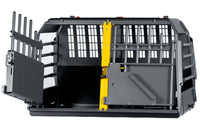
Aluminum crates are built from solid sheets of aluminum alloy. The walls are panels, not grids. Ventilation comes from punched or stamped holes rather than open space between bars. The structure distributes force across a solid surface rather than concentrating it at wire intersections. This difference in construction is the root cause of almost every practical difference between the two types.
Worth noting: not every metal crate is an aluminum crate. Some heavy-duty crates are made from steel, which is heavier and can rust. True aluminum crates are made from aluminum alloy, which is lightweight relative to its strength and naturally rust-resistant. When you see a premium aluminum dog crate, you are looking at a different material category, not just a stronger version of wire.
Wire crates have earned their dominant position in the market for real reasons. They work well for a large population of dogs and owners, and dismissing them entirely would be misleading.

The open grid design of a wire crate allows air to circulate freely on all sides at all times. For dogs that run warm, for households in hot climates, or for dogs who settle better when they can see what is happening around them, wire is genuinely advantageous. A dog who watches their owner move around the kitchen from their crate is a different experience from a dog enclosed in solid walls.
For social dogs who take comfort in visual connection with their family, the openness of a wire crate can actually reduce anxiety rather than increase it. This is an important nuance. The assumption that all anxious dogs do better with more enclosure is not always accurate. Some dogs are anxious specifically because they cannot see their environment.
Wire crates are the most accessible option on the market. A quality medium-sized wire crate can be found for $50 to $150 at any major pet retailer. For a new dog owner, for a foster situation, or for someone who needs a crate while they figure out what their dog actually needs, wire is the low-risk starting point. The cost of being wrong is low.
This also makes wire a reasonable first crate for puppies. Young dogs are still developing their habits. Many puppies who would have destroyed a wire crate at ten months are perfectly content in one at two years. Starting with wire and upgrading if necessary is a legitimate strategy, and it protects you from overinvesting before you understand your specific dog.
Wire crates fold flat in seconds. This practical reality matters for a lot of households. Moving a wire crate to another room, taking it to a relative's house, loading it into a car for a weekend trip, or storing it under a bed when not in use are all genuinely easy with a wire crate. For owners who need flexibility more than permanence, wire has a real advantage here.
Most wire crates include a divider panel that lets you section off part of the crate for a puppy and expand the space as the dog grows. This is genuinely useful for crate training, since an oversized crate can encourage a puppy to use one end as a bathroom. Aluminum crates less commonly include this feature, and sizing up means buying a larger crate outright.
The limitations of wire crates are well documented among owners of larger breeds, working dogs, and dogs with behavioral challenges. These are not edge cases.
The most common failure point is the door. A determined dog, particularly a dog in distress from separation anxiety, applies sustained lateral pressure to a wire crate door. Wire bends. Once a dog discovers that the crate yields to force, the behavior escalates. What follows is usually a damaged crate, a loose dog in the house, and potentially an injured animal from sharp edges created by the bending wire.
Even without escape attempts, wire crates pose ongoing safety questions. Bent or worn wires develop sharp points. A paw or jaw caught between bars during stress behavior is a real injury risk. Owners who discover this the hard way often wish they had made a different decision from the start.
Wire crates are also genuinely harder to clean than most people expect. Hair, dander, and debris embed in every intersection of the wire grid. If a dog has an accident in a wire crate, cleaning the tray and hosing down the grid are two separate tasks, and neither is as simple as wiping down smooth aluminum walls.
Finally, the plastic tray that lines the bottom of most wire crates is a chronic weak point. It cracks, it scratches, it absorbs odors over time, and the sound of a dog's nails on plastic at 3 a.m. is something owners only experience once before they start investigating alternatives.
Aluminum dog crates were not designed to replace wire crates for every dog. They were designed to solve specific problems that wire crates cannot solve, and they do that job extremely well.

The core advantage of an aluminum dog crate is its resistance to deformation. Solid aluminum panels do not bend the way wire grids do. The force from a dog pushing against a wall is distributed across the full surface of the panel, not concentrated at individual bar intersections. For large breeds, powerful working dogs, and dogs with escape behavior, this structural difference is the entire argument.
Dogs who have worked their way out of multiple wire crates have met genuine barriers in properly built aluminum enclosures. The crate does not respond to force in a way that rewards continued effort. For dogs learning that their crate is not something to fight, this matters as much as the containment itself.
Aluminum crates are smooth on the interior. There are no wires to bend into sharp points, no gaps sized to trap a paw, and no edges that wear dangerously over time. For owners who crate a dog unsupervised, particularly an anxious dog, this reduction in injury risk has real value. A crate should be the one place a dog is definitively safe, and aluminum's smooth construction supports that in a way wire physically cannot.
The ventilation holes in premium aluminum crates are engineered with this in mind. They are sized to allow airflow without providing a point of leverage for a dog's teeth or nails. It is a detail that matters most for dogs who are actively trying to escape, but the benefit extends to any dog who might accidentally snag a paw during normal movement.
Aluminum crates can be hosed down. Wipe the interior, spray out the floor, and the crate is clean. No grid intersections to work around, no plastic tray to replace, no rust to manage. For daily-use crates in homes with active dogs, this simplicity compounds into a significant quality-of-life advantage over months and years.
Aluminum is naturally rust-resistant. Unlike steel or the wire used in many budget crates, aluminum does not require protective coating to prevent oxidation. This keeps the crate safe for your dog and looking clean for much longer than alternatives.
Solid walls do not rattle. There is no plastic tray to amplify the sound of shifting weight. For dogs crated at night or in bedrooms, and for owners who have lost sleep to the sound of a wire crate shifting on hardwood floors, this is a genuine quality-of-life improvement that sounds minor until you experience the difference.
Some dogs escalate their anxiety when they can see stimuli they cannot respond to. A delivery truck pulling up, a neighbor walking by the window, another dog visible from the crate. For these dogs, the enclosed walls of an aluminum crate actively reduce the trigger exposure that fuels stress behavior. It is not isolation. It is management of visual input in a way that wire crates structurally cannot provide.

Here is how the two crate types stack up across every major category a dog owner should consider before buying.
|
Category |
Aluminum Crate |
Wire Crate |
|
Durability |
Extremely high — solid alloy panels resist bending, chewing, and impact |
Moderate — wire grid can bend under sustained pressure from large or anxious dogs |
|
Safety |
Smooth walls, no sharp edges; controlled ventilation holes |
Risk of sharp edges from bent wires; gaps can trap paws or jaws |
|
Escape Resistance |
Very high — welded seams, reinforced latches, no flex points |
Lower — determined dogs can bend bars or manipulate door latches |
|
Ventilation |
Good — strategically placed holes; more controlled airflow |
Excellent — fully open grid allows maximum airflow on all sides |
|
Visibility for Dog |
Partial — solid walls reduce visual stimulation (helpful for anxious dogs) |
Full — dog can see entire room; good for social dogs, bad for reactive ones |
|
Weight |
Heavier — medium crates typically 35-50 lbs |
Lighter — most wire crates fold flat and are easier to lift |
|
Storage |
Collapsible models fold to ~8 inches; stationary models need permanent placement |
Folds flat easily; most models collapse in seconds |
|
Ease of Cleaning |
Very easy — hose it down, wipe clean, no crevices |
Harder — wire grid traps hair, dander, and debris in every opening |
|
Rust Resistance |
Naturally rust-proof aluminum |
Can rust over time, especially in humid environments |
|
Cost |
$250 to $600+ depending on size and model |
$50 to $200 depending on size and brand |
|
Noise |
Quiet — solid walls absorb movement sounds |
Can rattle; plastic tray can be noisy when dog shifts |
|
Best For |
Escape artists, anxious dogs, working dogs, long-term home use |
Calm/well-trained dogs, puppies, budget-conscious buyers, crate training beginners |
The honest answer is that not every dog needs an aluminum crate. For a calm, well-adjusted dog who takes to crating easily, a quality wire crate is a perfectly reasonable choice. The investment in aluminum is justified when the situation calls for it.
Escape artists and destructive dogs: If your dog has already damaged or escaped a wire crate, this is the most direct signal that aluminum is the right next step. Continuing to replace wire crates is more expensive in the long run and puts your dog at risk every time.
Dogs with separation anxiety: Severe separation anxiety often manifests as sustained, forceful crate behavior. These dogs need a crate that does not reward their efforts with movement or deformation. Aluminum, particularly purpose-built high-anxiety models, is designed specifically for this situation.
Large and working breeds: Larger dogs put more structural stress on crates just by moving around. Breeds like Rottweilers, Belgian Malinois, German Shepherds, and Pit Bulls that carry high drive and high physical capability often outgrow what a wire crate can handle.
Dogs who will be crated long-term: If you plan to use a crate as a permanent fixture in your dog's routine for years, aluminum's durability and ease of cleaning make it the better long-term investment. The higher upfront cost amortizes across the life of the product.
Reactive dogs or dogs needing visual management: For dogs whose anxiety is triggered by visual stimuli, the solid walls of an aluminum crate do actual behavioral work that wire cannot replicate.
Wire crates are appropriate and practical for a wide range of situations. You do not need to upgrade if the situation does not call for it.
Puppies being introduced to crating for the first time are reasonable candidates for wire. The transparency can help them feel less isolated during the adjustment period, and the lower cost makes sense before you know how your specific puppy will respond to crating as they mature.
Calm, well-trained adult dogs who have never shown escape or destructive behavior in a crate do not need the additional structure of aluminum. If your dog walks into their wire crate willingly, settles without protest, and has never tested the door, there is no problem to solve.
Dogs used only for short crating periods or in supervised situations are also reasonable wire crate candidates. The risk calculation changes when someone is home and checking on the dog regularly versus a dog crated alone for an eight-hour workday.
The price gap between a quality wire crate and a premium aluminum crate is real and worth addressing directly. A mid-range wire crate for a large dog might cost $80 to $150. A comparable-size aluminum crate from a reputable manufacturer runs $250 to $500 or more. That is a meaningful difference.
The case for aluminum on cost grounds comes down to the replacement cycle and the warranty. Wire crates damaged by destructive dogs need to be replaced. Owners of escape-prone dogs sometimes cycle through two or three wire crates in a year. An aluminum crate from a manufacturer offering a lifetime warranty changes that equation entirely. You buy once.
It also helps to think about the total cost of a crating incident. A dog who escapes a damaged wire crate and has access to the house unsupervised creates a different risk than a contained dog. Property damage, potential injury, and the stress of an unexpected emergency are costs that do not show up in the price tag comparison.
That said, spending $400 on an aluminum crate for a calm, well-adjusted dog who has never once challenged their wire enclosure is not a sound financial decision. Match the investment to the actual need.
Regardless of which direction you go, a few quality indicators apply to both crate types.
For wire crates, look for gauge thickness in the wire itself. Heavier-gauge wire bends less under pressure. Look for a powder-coated finish to slow rust. Check the door latch mechanism to make sure it cannot be nosed open from the inside. And verify that the plastic floor tray is solid and fits snugly without flex points.
For aluminum dog crates, look for welded construction over riveted. Welds create continuous bonds; rivets are stress points. Confirm the alloy grade if specified. Check that ventilation holes are on multiple surfaces, not just one panel. Verify the latch design requires more than a single push to open. And always confirm the warranty terms in writing before purchasing.
Our team at AdeoPets is available by phone at 888-979-5566 and via live chat if you want help narrowing down which option fits your specific dog and situation. We have worked with owners of every breed and temperament, and we will give you a straight answer.

No. Aluminum crates excel for dogs with escape behavior, severe anxiety, reactive tendencies, or high physical strength. For calm, well-trained dogs, a quality wire crate works fine and costs significantly less.
Yes, in certain circumstances. Wire crates that have been bent or damaged develop sharp edges that can cut paws or skin. Bars sized to allow a paw or jaw to pass through and then get stuck are an injury risk, particularly during stress behavior. Smooth-walled aluminum crates eliminate this risk category.
Yes. Premium aluminum crates are designed with ventilation holes on multiple panels that provide adequate airflow for healthy dogs in normal home temperatures. They are not as open as wire, but they are not sealed containers. Dogs with specific medical conditions requiring maximum airflow should prompt a conversation with a veterinarian before selecting a crate type.
Most wire crates are extremely simple to set up and fold down without tools. Collapsible aluminum crates from quality manufacturers have closed this gap significantly, with setup times under a minute in many cases. Stationary aluminum crates take more effort but are not intended to be moved frequently.
A well-maintained wire crate used by a calm dog may last many years. An aluminum crate from a reputable manufacturer with a lifetime warranty can, in principle, outlast the dog it was purchased for. For owners who plan to use a crate as a permanent fixture and do not want to replace it, aluminum is the more durable long-term investment.
Absolutely. Many owners start with wire to assess their puppy's temperament during crate training and upgrade to aluminum if the dog shows escape tendencies, destructive behavior, or high anxiety as they mature. This is a sensible approach that avoids overinvesting before you understand what your specific dog needs.
The aluminum dog crate vs wire crate question has a clear answer once you know what you are actually solving for. Wire crates are affordable, widely available, well-ventilated, and perfectly adequate for calm, cooperative dogs. For that population, there is no reason to spend more.
Aluminum dog crates are the right choice when the situation demands it: escape-prone dogs, severe separation anxiety, large and powerful breeds, long-term daily use, or dogs who need visual management to settle. In those situations, no wire crate is a substitute for solid aluminum construction, a welded frame, and a latch that holds under real pressure.
If you are not sure which category your dog falls into, or if you want a second opinion on which specific crate fits your situation, call us at 888-979-5566 or start a live chat at AdeoPets.com. Browse our full selection of aluminum dog crates, heavy-duty dog crates, and dog kennels and find the crate your dog actually needs.