May 01, 2019
0

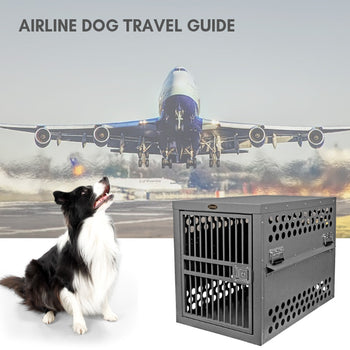
If you've ever Googled how to keep your dog safe in the car, you've probably run into this question pretty quickly. Should you use a dog car barrier or a dog crate? It seems like a simple question — but the answer is a little more nuanced than most people expect.
The short version is this: both options are meaningfully better than letting your dog ride loose in the vehicle, but they are not equal when it comes to crash protection. Understanding the difference between the two could genuinely matter in an emergency.
In this guide, we'll walk through how each option works, what the research and safety standards actually say, and how to choose the right setup for your dog, your vehicle, and your priorities.
Before we dive into the comparison, it's worth spending a moment on why this question matters so much.
A 60-pound dog can turn into a 2,700-pound projectile in a crash where the car is traveling at 35 mph. That's not a scare tactic, it's physics. When a vehicle stops suddenly, everything inside it continues moving forward at the speed the car was traveling. Without proper restraint, your dog becomes a serious hazard to themselves, to passengers, and to the driver.
The one thing that nearly every safety expert and experienced dog owner agrees on is that pets should never ride loose in the vehicle. A loose dog can distract the driver and, in a crash, will become a dangerous projectile.

So whether you choose a barrier or a crate, you're already making a responsible decision. The question is just which one is right for your situation.
A dog car barrier is a panel — usually made of metal mesh or steel — that divides your vehicle's interior. Most commonly, it separates the cargo area from the rear passenger seats in an SUV or wagon, though some models are designed to go between the front and rear seats.

A dog car barrier is a simple and effective way to keep your pup safely in the back seat or cargo area. It prevents them from jumping into the front seat or leaning into the driver's space — two common behaviors that can easily cause distractions. Rabbitgoo
The advantages of a barrier are real. They're relatively easy to install, they give your dog more open space to move around, and they work well for dogs that don't love being enclosed. For daily drivers who want a simple, flexible solution, a barrier is a practical and meaningful upgrade over nothing at all.
That said, it's important to understand what a standard barrier is — and isn't. Most barriers are designed for containment and distraction prevention, not crash protection. In an accident, a basic barrier may reduce your dog's ability to fly into the front of the vehicle, but it doesn't provide the structural integrity needed to protect your dog from the forces involved in a real collision.
While barriers help prevent your dog from causing distractions, they may not keep your dog secure in the event of a collision. For maximum safety, a car harness or crate is recommended. iHeartDogs
This is the key distinction. Containment and crash protection are not the same thing.
A dog car crate is a fully enclosed structure, typically made from steel or reinforced plastic, that your dog travels inside. Unlike a home crate, a quality vehicle crate is specifically designed to integrate with your car's cargo area and withstand the forces involved in travel.

Crash-tested crates provide safety by acting as a protective physical barrier, preventing the dog from being thrown about the vehicle during an accident or abrupt driving maneuvers. As long as the crates are the appropriate size, a dog will feel less impact from a collision since the space they're in is limited, provided the equipment is robust enough to maintain its integrity.
The word "crash-tested" is important here, and it's worth being specific about what that actually means. Not all crates that use that term have been evaluated the same way.
The most rigorous crash testing standards include ISO 27955, ECE R-17, and ECE R-44. ISO 27955 is an international standard for pet carrier crash testing. ECE R-17 and ECE R-44 are European automotive safety standards adapted for pet carriers. When a manufacturer claims their crate is crash-tested, it's worth looking for specific certification details, as some brands conduct their own testing without third-party verification.
The MIM Safe Variocage, for example, was developed in partnership with Swedish government agencies and has been independently evaluated using these standards. MIM Construction AB worked with Swedish government agencies to develop the Safe Pet Crate Test (SPCT), which is now a standard for assessing the safety of dogs traveling in crates, as well as the safety of human occupants during a collision.
One of the more distinctive engineering features of the Variocage is its telescopic design. In a rear-end collision, the Variocage will be compressed in a controlled manner, mimicking the automobile's crumple zone. The result is that the rear seat back will not be pushed forward by the crate, which helps prevent the cage and the dog from causing serious injury to human occupants.
This is what separates a properly engineered crash-tested crate from a standard containment crate. It's not just about keeping your dog inside the crate — it's about the crate itself performing safely during impact.
This is where the real difference shows up, and it's the most important part of this comparison.
A standard dog car barrier is primarily a containment and distraction tool. It keeps your dog in the cargo area, which is genuinely valuable — but it does not provide meaningful structural protection during a crash. If your vehicle is rear-ended, your dog is still subject to significant forward momentum inside an open cargo space.
A crash-tested dog crate, on the other hand, is engineered to respond to impact forces. The structure is designed to maintain integrity during a collision, the crumple zone absorbs energy rather than transferring it to your dog, and the enclosed design limits the distance your dog can travel during a sudden stop.
Well-built crates with secure mounting distribute crash forces far more effectively than restraint materials that can stretch or snap when it matters most. Emergency vets consistently see fewer severe injuries in dogs who were crated during accidents versus those relying on other methods alone.
It's also worth noting a practical safety feature that gets overlooked in most comparisons: what happens after an accident. Quality crates like the Variocage include emergency escape hatches, which allow you, or first responders, to access your dog even if the main door is blocked or jammed. In an open cargo area secured only by a barrier, a disoriented dog could escape into traffic before anyone can intervene.
Here's where things get more nuanced, and where your product lineup at Adeo Pets has a real advantage.
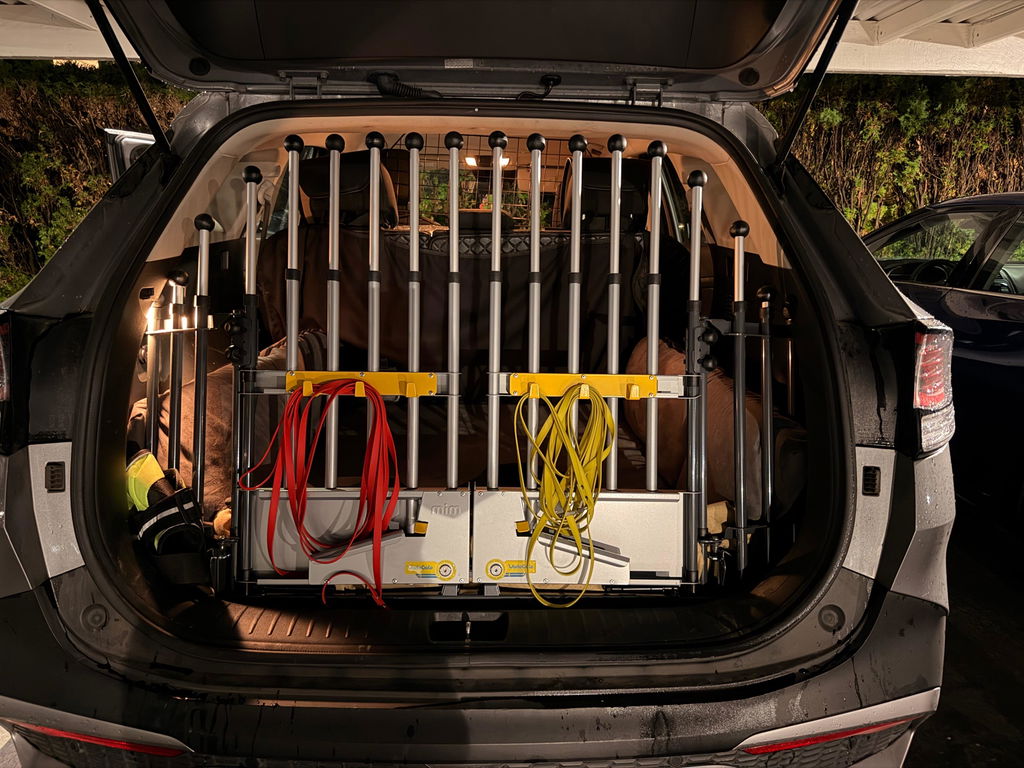
Not all barriers are created equal, and some are engineered to a much higher standard than the basic mesh or wire options. The MIM Safe VarioBarrier, for example, is one of the very few dog car barriers in the world that has been independently evaluated for crash safety.
The MIM Safe VarioBarrier has been tested and approved by the SP Technical Research Institute of Sweden using Crash Standard ISO 27955 to assure the safety of all vehicle occupants.
This matters because it moves the VarioBarrier out of the "basic containment" category and into genuine safety engineering territory. It's designed to work with your vehicle's built-in safety systems rather than simply sit in the cargo area. That's a fundamentally different product than the standard barriers you'll find at most pet retailers.
For drivers who prefer the open, flexible setup of a barrier over a fully enclosed crate — particularly for dogs that don't take well to enclosed spaces — a crash-tested barrier like the VarioBarrier is the most responsible choice available in that category.
There is no single right answer for every dog owner. The best choice depends on a few key variables.
Choose a crash-tested dog crate if:
You want the highest available level of crash protection for your dog. You travel frequently or take long road trips. Your dog is comfortable in an enclosed space. You drive an SUV, wagon, or hatchback with a proper cargo area.
Choose a crash-tested dog car barrier if:
Your dog is anxious or uncomfortable in a fully enclosed crate. You need more flexibility and open cargo space. You drive a vehicle where a full crate isn't practical. You understand the tradeoff in crash protection and want the best available barrier option.
Consider combining both systems if:
You want the most complete cargo containment setup. You travel with multiple dogs. You want both passenger protection and structured cargo space.
The MIM Safe Variogate paired with the VarioBarrier is a good example of this combined approach — the gate structures the cargo area while the barrier provides the separation between dogs and passengers. It creates a more complete containment system than either product does alone.
If there's one takeaway from all the research, it's this: any thoughtful restraint system is dramatically better than no restraint at all.
At 30 mph, a 40-pound dog generates 1,800 pounds of force in a crash. An unsecured dog becomes a projectile that can injure or kill everyone in the vehicle, including themselves.
Whether you start with a crash-tested barrier and upgrade later, or go straight to a fully enclosed crate, you're making a choice that protects your dog and everyone else in the vehicle. The important thing is to make that choice intentionally — and to understand what level of protection each option actually provides.
Dog Car Barrier
Crash-Tested Dog Crate
Understanding the difference between a barrier and a crate is the first step. The next is finding the right product for your vehicle, your dog, and how you actually travel.
Explore crash-tested dog crates for cars, available in single and double configurations to fit one dog or two.
Browse crash-tested dog car barriers for SUVs, including the standard VarioBarrier and the headrest-mounted VarioBarrier HR for vehicles without cargo anchors.
Or view the full dog car safety collection to find the combination that works best for your setup.