May 01, 2019
0

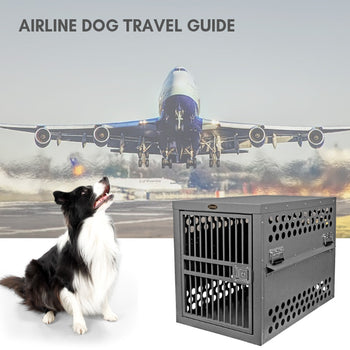

Some dogs treat every car ride like a parade. Others pant, drool, and tremble the moment the engine starts, and a few are sick before you reach the end of the street. If you are trying to figure out how to keep your dog calm during car rides, the most important thing to know is that calm is not one problem with one fix. A dog who whines out of fear, a dog who bounces off the windows out of excitement, and a dog who feels nauseous all need different help, and the wrong fix can make each of them worse.
This guide shows you how to work out which kind of car rider you have, the training that changes how dogs feel about the car, the pre-ride setup that makes every trip easier, and what the evidence says about calming aids and medication. It also covers something most calming guides skip. How your dog is secured affects how settled they feel, and it decides what happens to them if the ride goes wrong. We have spent seven years helping dog owners build safer car travel setups, and the dogs who ride best are almost always the ones who feel contained, comfortable, and unsurprised.
A car is a strange place to be a dog. The floor moves, the scenery streams past faster than a dog's eyes and inner ears are built to handle, engine and road noise rise and fall without warning, and there is no way to know where the ride ends. Dogs also learn quickly from association. If the only trips your dog takes end at the veterinarian or the groomer, the car itself starts to predict something unpleasant. A single frightening event, such as a hard stop or a collision, can start the same pattern in a dog who used to ride happily.
Fear and nausea also feed each other. A dog who feels queasy begins to dread the car, and a dog who is already anxious produces drool and restlessness that look a lot like motion sickness. That overlap is why veterinary resources point out that only a veterinarian can say for certain whether a dog's signs come from motion sickness, anxiety, or both. If your dog drools heavily or vomits, treat it as a medical question first and a training question second.
There is a safety reason to care as well. A dog who paces, barks, or climbs between seats is a driver distraction, and Consumer Reports notes that loose pets can pull a driver's attention away from the road. A calm, contained dog is a better passenger for everyone in the vehicle.
A 2006 study in the Veterinary Record followed 62 dogs with car travel problems and sorted them by the pattern of their behavior. The researchers described five groups: excitable, nausea, tense, attention-seeking, and elimination. Every group improved with treatment, which combined a pheromone collar with general behavioral advice, but the improvement was uneven and the study was not blinded. The useful takeaway is not the treatment. It is the idea that dogs struggle in cars for different reasons, and that the reason shapes the plan.

Spend two or three ordinary rides simply watching your dog before you try anything new. Most dogs fall into one of the patterns below, and many show a blend.
Tense dogs tremble, pant when the car is not hot, lick their lips, yawn repeatedly, whine, press against you, or try to avoid getting in at all. These dogs need the car to become less frightening, which means slower exposure and positive associations, not more miles. Pushing a fearful dog through a long trip to get used to it usually backfires.
Excitable dogs bark, spin, lunge at windows, or hop between seats. They are not scared. They are overstimulated and have not learned that the car is a place for settling down. These dogs benefit from exercise before the ride, fewer visual triggers, a defined place to ride, and rewards for calm behavior.
Nauseous dogs drool heavily, swallow or smack their lips, grow quiet and listless, and may vomit. The signs can begin before the car even moves, because the dog has learned what is coming. Nausea is a physical problem, so this dog needs your veterinarian involved, which we cover below.
Plenty of dogs are a combination, such as a dog who starts out nervous, turns queasy, and then becomes frantic. If you work on the fear and ignore the nausea, training stalls because the dog keeps feeling sick in the car. If you treat the nausea and ignore the fear, the dog may stay wary. Address both.
The approach behaviorists recommend for car fear is desensitization paired with counterconditioning. In plain terms, you introduce the car in small steps and pair each step with something your dog loves, so the car stops predicting stress and starts predicting good things. The American Kennel Club notes that, depending on how strongly a dog reacts, you may need to begin with the car parked in the driveway and your dog well back from it. Move at your dog's pace. If lip licking, panting, or whining returns, you moved too fast, so go back to the last step that felt easy.
Start with a parked car and the engine off. Open the doors and let your dog approach on their own. Toss treats near the car, then onto the floor of the vehicle, then onto the seat. Some dogs will eat a meal in the parked car, which builds a strong positive association.
Close the doors and sit with your dog for a few minutes, still with the engine off. Reward relaxed body language, such as lying down or a soft, loose posture.
Turn the engine on while the car stays parked. Keep sessions short and end on a calm moment.
Roll to the end of the driveway and back, rewarding calm behavior. Then drive once around the block.
Add short trips to places your dog loves, such as a park, a trailhead, or a friend's house. Make most rides end somewhere fun so the car stops meaning the vet.
Lengthen the rides gradually, adding a few minutes at a time once your dog is relaxed at the current length. Save highway driving for last.

If you can recruit a helper to ride beside your dog and hand out rewards while you drive, the process goes faster and your attention stays on the road. If your dog vomits, do not scold. Punishment gives your dog one more reason to dislike the car.
The same ladder works for dogs who get too excited, but the reward changes. Instead of rewarding relaxed body language near something scary, you reward calm sits and downs near something thrilling. End the session when your dog erupts, then try again a little later. It also helps to vary your destinations. If every ride ends at the dog park, the car becomes a promise of chaos. Mix in rides that end at home, and when you do drive toward a favorite spot, be ready to turn around if your dog gets wound up.
Training builds the foundation, but small choices before each trip affect how your dog feels the moment the door opens. Exercise comes first. A walk, a sniffing session, or a puzzle toy burns off nervous or excited energy, and a tired dog settles more easily. Give your dog time afterward to cool down, drink, and use the bathroom before you load up.
Skip the large meal right before departure, since a full stomach makes queasiness more likely, and offer small sips of water along the way. Keep the cabin comfortably cool and well ventilated, and crack a window slightly so your dog can focus on scents instead of pacing. Do not open it far enough for your dog's head to stick out, which invites eye injuries from road debris and a dangerous jump or fall.
Reduce what your dog has to process. Window shades or a light cover over a crate cut visual stimulation for dogs who react to passing traffic, and a familiar blanket or an item that smells like you gives an anxious dog something steady to settle on. Soft music can help too. Several studies have found that dogs relax to slow, simple classical music such as solo piano, and white noise can mask sounds that set a dog off.
Finally, check your own energy. Dogs read human emotion, so a driver who is tense, hurried, or irritated can pass that tension straight to the back seat. An unhurried departure routine and an even voice make a real difference.
Calming products are the most tempting shortcut, and they deserve a straight look. Dog-appeasing pheromone, often shortened to DAP, is a synthetic version of a comforting scent that nursing mother dogs release. In the 2006 Veterinary Record study, dogs wearing a DAP collar improved across the groups, with the greatest gain in the nausea group and the least in the excitable group. That study was not blinded or placebo controlled. A later placebo-controlled trial of a DAP gel in 28 dogs at a veterinary visit found mixed behavior changes rather than a clear, across-the-board calming effect. The fair reading is that pheromone products help some dogs a little and work best as one piece of a plan. If you try a spray made for travel, follow the label, which generally calls for treating the car or bedding ahead of time rather than spraying the dog.
Calming collars, snug anti-anxiety vests, and similar products carry little risk, but results are uneven, and plenty of owners report that they did nothing for their dog. If you want to test one, try it on a few ordinary rides, change only that one variable, and watch your dog's body language so you can tell whether it helped.
Nausea is different, because it is a physical condition rather than a feeling. Cerenia (maropitant citrate) is the only FDA-approved medication for preventing vomiting from motion sickness in dogs, according to its manufacturer, and it is available by prescription for dogs four months and older. It is not a sedative, and it does not treat anxiety. Motion sickness remedies made for people are not FDA-approved for dogs, so dosing a dog from the medicine cabinet is guesswork. Do not give your dog any medication for car rides without talking to your veterinarian first.
For dogs with severe fear, such as panic, destructive behavior, or refusal to approach the car, your veterinarian can discuss anti-anxiety medication as part of a broader plan that includes training. That is a medical decision made with a professional who knows your dog's health history, not a shortcut to try on your own.
Where and how your dog is secured does two jobs at once. The first is comfort. A contained dog cannot pace, cannot be tossed off the seat by a sharp turn, and often sees less of the world rushing past. Veterinary behavior resources note that crates reduce stimulation and prevent injury in dogs who cannot sit still in a moving car. There is one condition. The dog has to be comfortable in the crate first, because putting an untrained dog in a crate for car rides can deepen the dislike of the car. Introduce the crate or harness at home, with treats and no pressure, long before the first drive.
The second job is safety, and it matters most if something goes wrong. Pet safety advocates cited by Consumer Reports estimate that a 60-pound dog in a 35 mph crash can become a projectile carrying roughly 2,700 pounds of force. That puts the dog, the driver, and every passenger at risk. Consumer Reports also points out that there are no government standards for pet travel products, so a label that says crash tested often reflects only the manufacturer's own claim. The nonprofit Center for Pet Safety exists in part because of that gap, and its approach is a good model for the questions to ask. What standard was the product tested to, who did the testing, and can you see the results?
A crash-tested crate gives your dog a defined, enclosed space, which suits dogs who settle best when they are contained. The MIM Safe Variocage is built from steel with a telescopic design that works with your vehicle's crumple zone, so the crate compresses in a controlled way in a rear-end collision instead of staying rigid. MIM Safe states that the Variocage is certified to ISO 27955, ECE R-17, and ECE R-44 and was tested by the SP Technical Research Institute of Sweden. It also includes an emergency escape hatch so you can reach your dog after a rear collision.

The line includes the Variocage Double, which holds two dogs or one large dog, the Variocage Compact for hatchbacks, and the Variocage MiniMax for small dogs and cats. Because a crate has to fit both your dog and your vehicle, our team walks customers through measurements before an order ships. Our guide on what size dog crate you need for your car explains how the sizing works.
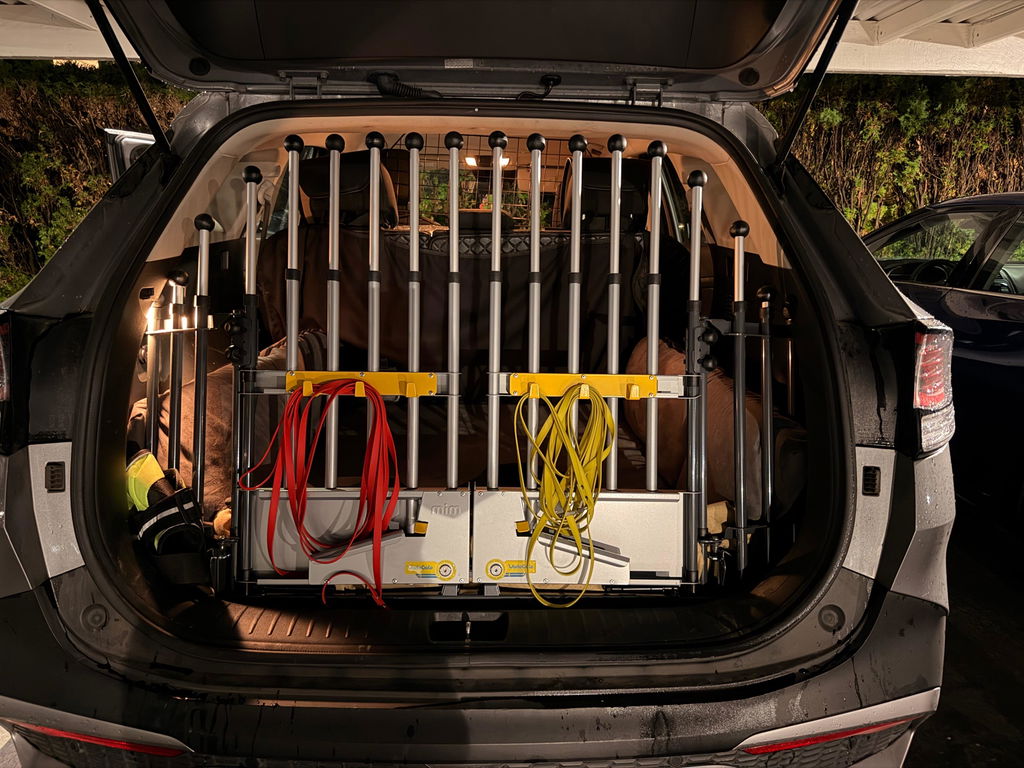
Some dogs ride best with more room and a view, and some households need space for gear or for more than one dog. A crash-tested cargo barrier or gate creates a secured area in the back of an SUV or wagon without fully enclosing the dog. The MIM Safe Variogate and the VarioBarrier Universal work together to build that contained area, and our comparison of a dog car barrier versus a crate covers how to decide between the two approaches.
A heavy-duty home crate is a different product category. As our guide to heavy-duty dog crates for large breeds explains, a crate that resists escape at home is not the same thing as a crate tested to protect a dog in a collision.

Dogs who are comfortable riding on the back seat can use a crash-tested harness. The AllSafe dog seat belt harness is tested to DIN 75410-2, ECE R-17, and FMVSS 213, with crash testing at speeds up to 30 mph using a 50-pound dummy at the ADAC Technology Centre and a 75-pound dummy in the United States. It is intended for the rear seat only, never the front, and it is not designed for small toy breeds. A harness will not stop a dog from spinning or barking, so for excitable riders a crate or barrier is often the better match.
Most of the common mistakes come from good intentions. Owners reserve car rides for the vet, so the car predicts bad news. They scold a dog for whining or vomiting, which adds stress to a ride that was already hard. They jump straight to a long trip to get a nervous dog used to it, when the dog needed a series of small steps first. They put an untrained dog in a crate and close the door, or they let a dog roam the cabin or hang out of a window because it seems to make the dog happy.
The most dangerous mistake is leaving a dog alone in a parked car, even briefly. A vehicle can heat up rapidly, and a dog can be in serious trouble within minutes. If a stop means leaving the car, take your dog with you or plan the trip so you are not stopping somewhere you cannot bring them.
Call your veterinarian if your dog vomits or drools heavily on most rides, panics when you approach the car, tries to injure themselves or escape while riding, or has suddenly become a nervous rider after years of calm trips. A sudden change can sometimes point to pain or illness, such as an older dog with sore joints who dreads jumping in, rather than a training problem. Puppies deserve a mention too. Motion sickness is common in young dogs and often eases with age and experience, but a puppy who vomits on every ride is worth raising at the next visit.
Bring notes. Write down when the signs start, how long they last, and what the ride was like. That detail helps your veterinarian sort nausea from fear and choose the right next step.
Start by identifying whether your dog is fearful, excitable, or nauseous. For fear, use gradual desensitization with rewards, beginning with the parked car. For excitement, exercise your dog first and reward calm behavior. For nausea, talk to your veterinarian. In every case, a comfortable temperature, a familiar blanket, and a secure place to ride help.
Shaking, panting when the car is not hot, and whining are common signs of fear or stress, and they can also appear with nausea. Dogs often learn to dread the car after a bad experience, or when the car only ever means a vet visit. If the signs come with drooling or vomiting, ask your veterinarian about motion sickness.
Not without veterinary guidance. Motion sickness medicines made for people are not FDA-approved for dogs, and the right choice and amount depend on your dog's size, health, and any other medications. Your veterinarian can prescribe options made for dogs, including a medication approved for preventing vomiting from motion sickness.
Many puppies do. Motion sickness often improves with age and with repeated, positive car experiences. Dogs who stay sick, or who have developed fear because of repeated sickness, usually need both training and a veterinary plan.
It depends on your dog and your vehicle. Dogs who settle in enclosed spaces often do well in a crash-tested crate. Dogs who need more room, or who share the cargo area with another dog or gear, may suit a crash-tested barrier or gate. Calm dogs who ride in the back seat can use a crash-tested harness. Whatever you choose, introduce it at home first. Our team can help you narrow it down at 888-979-5566.
In the cargo area of an SUV or wagon, secured in a crash-tested crate or behind a crash-tested barrier, or on the back seat in a properly fitted crash-tested harness. Keep dogs out of the front seat, since airbags are designed for adult passengers, and never let a dog ride loose.
A common guideline is a stop about every two hours for water, a bathroom break, and a short walk. Anxious dogs and dogs prone to nausea may need shorter intervals. Never leave your dog in the parked car while you take your own break.
Knowing how to keep your dog calm in the car comes down to a few steady habits. Work out why your dog struggles, train in small steps, prepare before each trip, involve your veterinarian when nausea or severe fear is in the picture, and give your dog a secure place to ride that they have learned to like. Calm and safe are not competing goals. A dog who feels contained and comfortable is easier to drive with, and a dog who is properly restrained is protected if the unexpected happens.
If you are weighing options for your own vehicle, our collection of crash tested dog crates for cars and our cargo gates and barriers are a good place to start, and our overview of the best dog crate for car travel breaks down how to choose. Fit depends on your dog and your vehicle, so when you contact us with your vehicle measurements, our US-based team will help you choose the right size and back it with our Fit Guarantee. Call 888-979-5566, start a live chat, or send a message through our contact page.
AdeoPets has served dog owners for seven years and holds a 4.9-star rating across more than 600 customer reviews. If you find a lower price online, our Price Match Guarantee has you covered.