May 01, 2019
0


Walk into any pet store and the dog crate aisle will tell you one story: sizes go from small to large, prices go from cheap to expensive, and the boxes all promise the same thing. What they do not tell you is that a crate that works perfectly for a calm Beagle can be completely wrong for a Belgian Malinois. Or that a wire crate that suits a well-adjusted Golden Retriever is a liability with a dog that has separation anxiety.
Choosing the right home dog crate for your breed is more nuanced than reading a weight chart. It comes down to three things: accurate sizing based on your actual dog's measurements, matching the crate type to your dog's temperament and behavioral tendencies, and understanding how your specific breed's instincts and energy level affect which features actually matter. This guide covers all three.

Most crate sizing charts default to weight ranges, and while weight is a useful starting point, it is not the whole picture. A 40-pound Bulldog and a 40-pound Whippet are the same weight but have completely different body shapes. The Bulldog is wide and short with a low center of gravity. The Whippet is long and narrow with a deep chest. A crate sized by weight alone will fit one of them comfortably and feel cramped or disorienting for the other.
Breed also informs the behavioral expectations that should drive your crate type decision. A Siberian Husky and a Bichon Frise might both be classified as medium dogs, but they have vastly different energy levels, escape tendencies, and reactions to confinement. The right crate for your dog starts with knowing your breed's typical traits, not just their weight class.
The same logic applies to crate material. Wire crates are adequate for a large segment of well-adjusted dogs. Aluminum dog crates become essential when the breed involves high drive, strong prey instinct, or known escape behavior. Understanding this upfront saves you from replacing a damaged crate after the fact.
Breed size charts give you a starting estimate. Your dog's actual measurements give you the answer. Always measure before buying.

With your dog standing naturally, measure from the tip of the nose to the base of the tail (not the tip). Add 2 to 4 inches to that number. This is your minimum interior crate length. The extra inches allow your dog to stretch out comfortably without pressing against the walls.
With your dog standing or sitting, measure from the floor to the top of their head. For breeds with erect ears (German Shepherds, Dobermans, many working breeds), measure to the tip of the ear instead. Add 2 to 4 inches. This is your minimum interior crate height. Your dog should be able to sit upright and look straight ahead without their head touching the ceiling.
If you plan to use a crate mat or thick orthopedic pad, factor that into your height measurement. A 2-inch mat raises your dog's effective standing height by 2 inches. Measure with that in mind, especially for dogs close to the upper limit of a given crate size.
For puppies, measure their expected adult dimensions using AKC breed standards as a reference rather than their current size. Buy for the adult, use a divider panel to reduce the space during training. Oversized crates without a divider can work against housetraining, since a puppy with room to roam will use one end as a sleeping area and the other as a bathroom.
The table below reflects standard sizing conventions and breed groupings. Always cross-reference with your dog's actual measurements, as individual dogs within any breed vary.
|
Crate Size |
Dimensions (L) |
Weight Range |
Example Breeds |
Crate Type to Consider |
|
XS / Small |
18-24 inches |
Under 25 lbs |
Chihuahua, Maltese, Yorkshire Terrier, Papillon |
Wire or soft-sided; calm temperament dogs only |
|
Small / Medium |
24-30 inches |
25-40 lbs |
Beagle, French Bulldog, Cocker Spaniel, Corgi |
Wire standard; aluminum if destructive tendency |
|
Medium / Large |
30-36 inches |
40-70 lbs |
Border Collie, Siberian Husky, Labrador (female), Boxer |
Wire for calm dogs; aluminum for high-drive or anxious |
|
Large / XL |
36-42 inches |
70-90 lbs |
Labrador (male), Golden Retriever, German Shepherd |
Aluminum strongly recommended for working/high-drive |
|
XL / XXL |
42-48 inches |
90-110 lbs |
Rottweiler, Bloodhound, Akita, Irish Setter |
Heavy-duty aluminum or reinforced crate |
|
XXL / Giant |
48-54+ inches |
110+ lbs |
Great Dane, Mastiff, Saint Bernard, Newfoundland |
Purpose-built giant breed aluminum or kennel panel |
Note: These are interior length recommendations. Always verify interior dimensions with the specific crate manufacturer before purchasing, as nominal sizes (36-inch, 42-inch) vary in actual interior measurement across brands.

Getting the size right is step one. Getting the crate type right is step two, and it is where most owners make the decision that either works or fails within the first few weeks.
If your dog takes to crating without significant protest, does not attempt to escape, and is generally content to settle when asked, a quality wire crate is a sensible choice. Wire crates offer excellent ventilation, good visibility for dogs that settle by seeing their environment, and practical fold-flat storage. For breeds like Poodles, Cavalier King Charles Spaniels, most Labradors, and many medium-sized companion breeds in calm households, wire delivers solid value without the premium price of aluminum.
The key qualifier is behavior. If your dog has never challenged their crate, has no history of destructive behavior, and crates without issue, there is no practical reason to upgrade to a more robust option. Match the investment to the actual need.
Belgian Malinois, German Shepherds, Dutch Shepherds, Rottweilers, American Pit Bull Terriers, Siberian Huskies, and similar working or high-drive breeds bring energy levels and physical capability that can stress a wire crate in ways that calm companion breeds never would. These dogs are often stronger, more motivated, and more determined when they decide they want something, including out of their crate.

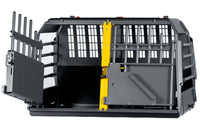
For these breeds, an aluminum dog crate is not a luxury. It is appropriate containment. Solid aluminum panels do not flex under pressure, welded construction eliminates stress points that wire crates develop over time, and a latch that requires two distinct actions to open is resistant to a dog who has figured out how to nose at simple mechanisms. Owners of working breeds who have invested in aluminum consistently report that the behavior of testing the crate stops much faster once the crate stops yielding.
Separation anxiety and reactivity to environmental stimuli are different problems that sometimes call for different crate solutions, and they are worth separating.
Dogs with genuine separation anxiety often exhibit sustained, forceful crate behavior when left alone. These dogs need a crate that does not reward that behavior with movement, bending, or deformation. An escape-proof aluminum crate with a reinforced door is specifically built for this scenario. The crate holds firm, and over time, the dog stops escalating because the effort produces no result. Pairing the right crate with a proper behavioral protocol and, if needed, veterinary support, produces far better outcomes than continuing to replace damaged wire crates.
Reactive dogs (those triggered by sights and sounds in their environment) sometimes do better in the visual enclosure that an aluminum crate's solid walls provide. A dog that can see a delivery truck from their wire crate and cannot respond will often escalate the behavior they can do, which is vocalize and pace and press against the crate door. An aluminum crate that limits that visual exposure reduces the trigger frequency. This is not a solution to reactivity, but it is a crate management decision that makes daily life easier.
Small breed dogs have their own crate considerations. The instinct to den is real in small breeds, and many small dogs feel more secure in a crate that feels cozy rather than spacious. Going too large on a small breed crate can backfire, particularly during housetraining, because the dog does not feel the den-like security that supports the natural reluctance to soil their sleeping space.
For small breeds with calm temperaments, soft-sided crates work well in supervised situations. For small breeds that are determined chewers or escape artists (and there are plenty, including Jack Russell Terriers, Dachshunds, and some terrier mixes), a wire or small aluminum option is more appropriate than soft fabric. Never assume a small dog cannot do serious damage to an inadequate crate.
Great Danes, Mastiffs, Saint Bernards, Newfoundlands, and similar giant breeds require crates sized to accommodate both their length and height, including enough headroom for a large head and ears. The structural weight of a giant breed dog pressing or leaning against a crate wall is not trivial. Lightweight wire crates and thin-gauge materials are not built for 150-plus-pound animals, and this is one area where the investment in a reinforced or aluminum option is directly tied to safety.
Giant breed dogs also need crates with floor stability. A crate that shifts or wobbles when a large dog enters or exits can be unsettling for the dog and can create stress around crate entry. Heavier, more stable construction supports a calmer crating experience.
Where a crate lives in your home affects how well it works, regardless of which crate you choose.
Dogs generally do better when crated in an area where they can hear or sense household activity without being in the center of high-traffic chaos. A quiet corner of a living room or bedroom is typically better than a laundry room or isolated space, particularly during initial crate training. Dogs are social animals and total isolation increases the emotional difficulty of crating.
For reactive breeds or dogs with anxiety, crate placement away from windows facing the street can meaningfully reduce trigger exposure. What your dog can see and hear from their crate matters, and positioning the crate with this in mind is a low-effort adjustment that can improve how quickly a dog settles.
Consider doorway access when selecting crate size. A 48-inch crate that cannot navigate through a standard doorway creates real logistical problems in a house. Measure doorframes if you are purchasing a large or giant breed crate. Collapsible aluminum crates have a practical advantage here: they can be disassembled, moved, and reassembled in the target room.
Most crates offer a single front-opening door as the default. Double-door configurations add a side door, which is particularly useful when the crate is placed in a corner or against furniture. The ability to enter from two directions makes daily use easier and gives you more flexibility in how you arrange your living space.
For most dogs, door configuration is a matter of owner convenience rather than a meaningful behavioral consideration. One exception is dogs in crate training who do better with a front-opening door that they can approach naturally rather than from the side. Once trained, the side door becomes a convenience, not a necessity.
Short-nosed breeds require more attention to ventilation than most. These dogs overheat more easily and can have breathing complications in poorly ventilated spaces. For these breeds, wire crates with maximum airflow are often preferred over more enclosed aluminum options unless behavioral needs require the upgrade. If using aluminum for a brachycephalic breed, confirm that the ventilation hole placement and quantity provide adequate airflow, and never place the crate in direct sunlight or a warm room.
Northern breeds are powerful, often escape-oriented, and built to handle cold much better than heat. Ventilation is important. These breeds are also known for being determined problem-solvers, which is part of what makes them so interesting to own and what makes wire crates a gamble. Many experienced Husky and Malamute owners report that standard wire crates are inadequate and move to aluminum or reinforced options relatively quickly. The combination of intelligence and physical capability means a motivated Husky will find any weak point in a wire design.
Herding breeds are mentally intense dogs. Boredom and under-stimulation are the primary drivers of problem behavior in this group, including crate behavior. The crate type itself matters less than the exercise and mental enrichment routine around crating. That said, herding breeds with anxiety or high reactivity do benefit from the reduced visual stimulation of an aluminum crate. Assess the individual dog rather than relying entirely on breed tendency.
Sight hounds have notably different body proportions than their weight suggests. Long, narrow bodies with deep chests and long legs mean that standard sizing charts can be misleading. A 70-pound Greyhound needs a crate sized for their length and height, not their weight. These breeds also tend to be sensitive and crate well with appropriate introduction, but their physical dimensions require extra care when selecting size.

Yes, if you buy for the expected adult size and use a divider panel during training. Most quality crates offer optional or included dividers. This is the most cost-effective approach for large breed puppies who will grow into a 42-inch or 48-inch crate over 12 to 18 months.
Too large is a real problem during housetraining because dogs will use the extra space as a bathroom area rather than holding their bladder. Once a dog is fully housetrained and crate comfortable, a crate with slightly more space than the minimum is fine for most breeds. During training, size to fit, then expand as needed.
No. A large, calm, well-trained dog with no escape or destructive behavior does perfectly well in a quality wire crate. The case for aluminum in large breeds is strongest when there is high drive, anxiety, or a history of crate challenges. The size and the material are two separate decisions.
For dogs with genuine separation anxiety who exhibit forceful or sustained escape behavior, a heavy-duty aluminum or escape-proof crate is the appropriate choice. Wire crates are not built to withstand this kind of sustained pressure and can create injury risk as they deform. If your dog's anxiety is severe, combine the right crate with guidance from a trainer or veterinarian for the best outcome.
Your dog should be able to stand without ducking, turn around without touching the sides, and lie fully extended without pressing against the walls. If any of those three things are not possible, the crate is too small. If your dog uses the far end of the crate as a bathroom during training, it may be too large.
Start by ruling out size and material issues. A crate that is too small, poorly ventilated, or rattles and shifts during movement is genuinely uncomfortable. If the crate is physically appropriate, the issue is likely introductory training. Go back to basics: open the door, reward voluntary entry, feed meals inside the crate, and build duration gradually. Never force a dog into a crate or use it as punishment.
Measure your dog before buying. Use length and height, not just weight. Add 2 to 4 inches to each measurement, then match to the interior dimensions of the specific crate you are considering.
Match crate type to temperament. Wire works for calm dogs. Aluminum dog crates are the right call for high-drive breeds, dogs with escape history, reactive dogs, and working animals. Do not under-invest for a dog who will test whatever you buy.
Consider your breed's specific traits. Ventilation needs vary. Body proportions vary. Energy levels and behavioral tendencies vary. What works for one owner's Labrador is not the default answer for every dog in that weight class.
If you want a second opinion before purchasing, our team at AdeoPets is available by phone at 888-979-5566 and via live chat. We carry a full range of dog crates and dog kennels from wire to heavy-duty aluminum and will help you find the right fit for your specific dog and home situation.