May 01, 2019
0

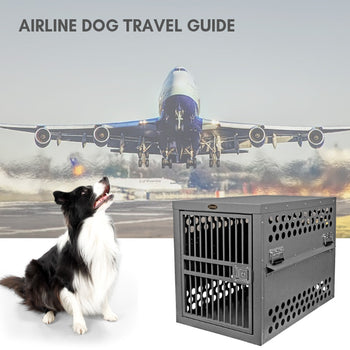
If you've spent any time researching dog crates for car travel, you've almost certainly come across the phrase 'crash tested.' It appears on product listings, marketing copy, and reviews across the industry. But there's a question underneath that phrase that most people never stop to ask: what does crash tested actually mean, and is it all equal?
The answer matters more than most people realize, and the difference between a product that is genuinely crash tested and one that merely uses the term in marketing can be the difference between a crate that protects your dog in a real accident and one that doesn't.
This article walks through what crash testing for dog crates actually involves, what the safety standards mean in plain language, and why the engineering behind a properly tested crate is worth understanding before you spend your money.

To understand why crash testing matters for dog crates, it helps to understand why it matters for everything else in your vehicle.
Modern automotive safety is built on the principle that protecting occupants requires understanding what actually happens during different types of collisions. That's why car safety ratings don't test for just one type of crash. They evaluate frontal impact, rear impact, and rollover performance separately, because each scenario creates different forces and different risks for everyone inside the vehicle.
Automobile safety ratings incorporate testing for frontal impact, rear impact, and rollover performance because automobile safety agencies recognize the unique and significant risks posed to passengers in each of these crash scenarios. They also understand automobile safety features, such as cargo areas and crumple zones, and how they must respond to protect passengers during accidents.
This same logic should apply to anything you place in your vehicle, including your dog. An unrestrained dog or a crate that fails during impact doesn't just affect your pet. It introduces a projectile into the passenger cabin that poses serious risk to everyone aboard.
Here's where things get important.
In the pet industry, there is no universal regulation requiring manufacturers to crash test their products. This means that a manufacturer can, and many do, apply the term 'crash tested' to a product that was evaluated under very limited conditions, by their own internal team, using criteria they defined themselves.
It is extremely dangerous to travel with a harness or dog crate that does not meet crash safety standards. Any wire crate, folding crate, plastic crate, or other pet safety travel product that is not properly crash tested may help avoid driver distraction, but will not provide proper protection in the event of an accident.
This matters because testing only for frontal impact, for example, tells you very little about what happens in a rear-end collision or a rollover, which are actually among the most common accident types on the road.
A dog crate that is not properly crash tested can burst apart in a frontal impact, rear end collision, or rollover accident. A dog can be ejected or harmed by the cage material failing. Dog crates without a crumple zone can alter the crash safety features of your vehicle, even when the crate is in the vehicle without a dog in it.
That last point is one that surprises many people. A rigid crate without crumple zone engineering doesn't just fail to protect your dog. It actively interferes with your vehicle's built-in safety systems.
When evaluating whether a crash tested dog crate is genuinely safe, there are specific international standards worth knowing.

ISO 27955 is an international standard developed specifically for the crash testing of pet carriers and crates in vehicles. It establishes test parameters for speed, impact type, dummy weight, and structural performance, and it requires evaluation by an independent third-party testing organization.
These are European automotive safety standards that have been adapted and applied to pet carrier testing. These standards come from the same regulatory framework that governs the certification of passenger vehicles and child car seats in Europe, making them among the most rigorous benchmarks available.
The SPCT is a standard developed specifically for dog travel crates. In 2009, the Technical Research Institute of Sweden (SP) in Boras developed this more rigorous testing method in conjunction with MIM Construction AB. It is now a recognized standard for assessing the safety of dogs traveling in crates, as well as the safety of human occupants during a collision.
What sets these standards apart from manufacturer self-testing is independent verification. When a product is certified under ISO 27955 or the SPCT by an accredited body like the SP Technical Research Institute of Sweden, it means the testing was conducted by engineers who have no financial stake in the outcome.

One of the most misunderstood aspects of crash-tested crate design is the crumple zone, and it's arguably the most important engineering feature to understand.
Your car already has crumple zones built into it. These are deliberately engineered sections of the vehicle body that compress in a controlled way during a collision, absorbing energy before it reaches the passenger compartment. This controlled deformation is what protects you in a crash.
A crate that sits rigidly in your cargo area without any crumple zone engineering disrupts this system. In a rear-end impact, the cargo area compresses and the crate gets forced forward, directly into the rear seats. The result can be catastrophic for passengers seated there, regardless of whether your dog was even in the crate.
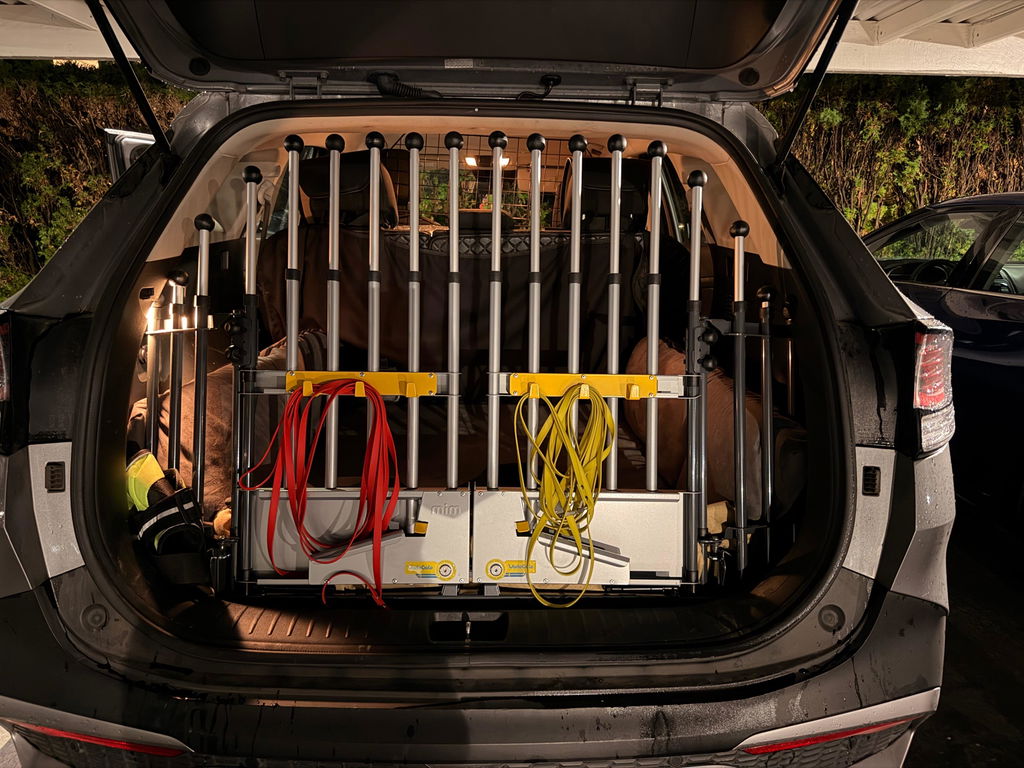
The Variocage crumple zone protects your dog by limiting the deformation of the crate in a rear-end collision. In a rear-end collision, the Variocage will be compressed in a controlled manner mimicking the automobile's crumple zone. The result is that the rear seat back will not be pushed forward by the crate, preventing the cage and the dog from causing serious injury to human occupants.
This telescopic compression is built directly into the Variocage's adjustable design. It's not a coincidence that the crate expands and contracts. That functionality is what allows it to respond to crash forces the same way your vehicle does.
The MIM Safe Variocage is not a pet product company that decided to add crash testing to its marketing. It comes from an automotive safety engineering background.

Over the past twenty years, MIM Construction AB has designed and manufactured over 350 crash tested automotive safety products effective in reducing the risk of serious injury or death for drivers, passengers, and pets. MIM has gained extensive experience and knowledge from hundreds of crash tests where MIM designs and products have been utilized.
The Variocage is the direct application of that automotive engineering experience to the specific problem of transporting dogs safely in vehicles. It was developed using the same principles that govern how car manufacturers engineer their vehicles to protect people.
The testing parameters are specific and demanding. Crash test performance of the MIM Safe Variocage was measured against the criteria established in ISO 27955, ECE R-17, ECE R-44, and SPCT with a dog dummy weighing 99 lbs in a single cage and two dog dummies weighing 77 lbs each in a double cage at speeds exceeding 30 mph.
These are not internal company tests. They are independent evaluations conducted by the SP Technical Research Institute of Sweden under established government automotive safety criteria.
Statistics help explain why all of this matters at a practical level.
According to the National Safety Council, over 2.5 million rear end collisions are reported every year, making them the most common type of automobile accident. This is where most pets are contained, which is why it is important to use crash tested pet safety products.
Rear-end collisions are not rare edge cases. They are the most statistically common accident type, and they are precisely the scenario for which the Variocage's crumple zone engineering is designed.
The proof of performance in real accidents is equally compelling. In accidents where insurance companies have declared vehicles total losses, with tremendous forces experienced, in all cases the driver, passengers, and the dog traveling in the MIM Safe Variocage survived in perfect health.
That kind of real-world track record, sustained over more than a decade, is what distinguishes a genuinely engineered safety product from one that simply carries the marketing language.
Beyond the testing and the crumple zone engineering, a few specific design features separate properly crash-tested crates from everything else.
This is a detail that most people overlook until they need it. In a serious rear-end collision, the cargo door of your vehicle may be jammed or inaccessible. Without an alternate exit, getting your dog out requires cutting through the crate, a stressful and dangerous situation in a critical moment. The safety escape hatch located at the rear of the crate allows you to remove your dog from the vehicle after a collision even if the main door is blocked.
Anchoring to your vehicle's cargo anchor points is a requirement, not an accessory. A crate that isn't properly anchored, regardless of its construction quality, can shift or become a projectile during impact. Proper installation is part of what the testing certifies.
The Variocage is constructed of steel that is flexible enough to absorb impacts and strong enough to retain its shape. It is specifically designed so that no feature on the crate can harm the dog, with the interior surfaces engineered to minimize puncture wounds and lacerations in the event of a collision.
If you're evaluating any crash-tested dog crate from any manufacturer, here are the questions that reveal whether the claim is meaningful:
What specific standards was it tested to? Look for ISO 27955, ECE R-17, ECE R-44, or SPCT. Vague references to 'crash testing' without specifying the standard mean very little.
Who conducted the testing? Independent third-party organizations like the SP Technical Research Institute of Sweden are credible. Manufacturer self-testing is not equivalent.
What accident types were included? Frontal, rear-end, and rollover testing together is the meaningful benchmark. Frontal-only testing leaves out the most common accident type.
Does the crate have a crumple zone? This is the engineering feature that determines whether the crate works with your vehicle's safety systems or against them.
Is there a proven real-world track record? Documentation of real accidents where the crate performed as designed is the most compelling evidence of all.

ISO 27955 is an international standard for crash testing pet carriers in vehicles. A crate certified under this standard has been independently evaluated for its performance during vehicle collisions, including the forces applied to both the animal and the vehicle occupants.
Yes. The Variocage is tested for front, rear, and rollover impacts under multiple independent standards. Rear-end testing is specifically where the crumple zone engineering is evaluated, and rear-end collisions are the most common accident type on the road.
The Safe Pet Crate Test (SPCT) was developed by the SP Technical Research Institute of Sweden in partnership with MIM Construction AB. It is a dedicated testing standard for dog travel crates that evaluates both the safety of the animal and the protection of human occupants.
Strapping down a crate is always better than leaving it unsecured, but it does not make a standard crate crash-safe. A rigid crate without crumple zone engineering can still disrupt your vehicle's safety systems during a rear-end impact and expose rear-seat passengers to serious risk.
MIM Construction AB has been developing crash-tested automotive safety products since 1986, and the Variocage has been in use for over a decade with a documented track record of protecting dogs and passengers in real-world accidents.
The phrase 'crash tested' is used loosely across the pet industry. Understanding what it actually means, what standards apply, who conducts the testing, and what engineering principles are involved, is how you separate products that provide real protection from those that only claim to.
A crate certified under ISO 27955, ECE R-17, ECE R-44, and the SPCT by an independent testing authority isn't just better marketing. It represents a fundamentally different approach to the problem of keeping dogs and passengers safe in a vehicle, one grounded in the same automotive engineering principles that protect you every time you drive.
If that level of protection matters to you, explore the MIM Safe Variocage lineup, available in single and double configurations for one dog or two, and reach out before ordering for a personal fit guarantee.